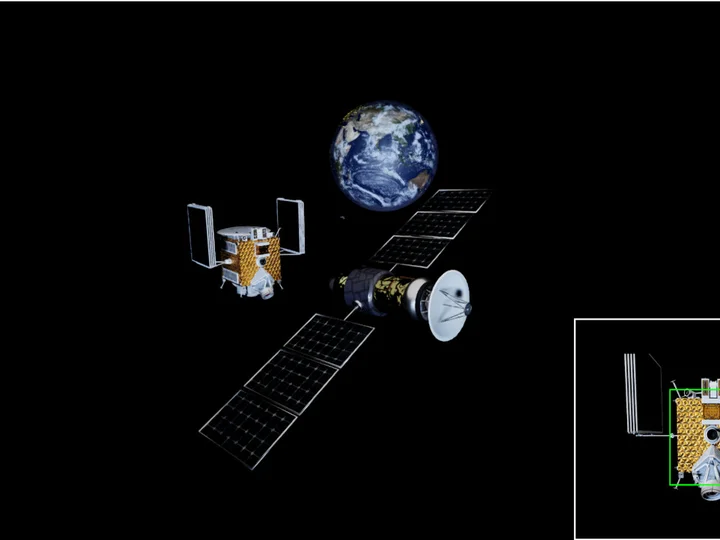
As orbital operations scale, autonomous robotic agents must balance capture efficiency with long-term debris mitigation and sustainability constraints. This architecture provides real-time policy evaluation for robotic manipulation in non-cooperative orbital regimes.
Coordinates multi-link robotic kinematics and compliant grappling end-effectors to safely contact and capture uncooperative, tumbling orbital targets without generating secondary fragments.
Computes fuel-optimal rendezvous paths that respect Keep-Out Zones, sensor sightlines, and thruster plume impingement constraints during close approach.
Embeds non-compensatory safety boundaries directly into action selection, guaranteeing passive abort trajectories and collision avoidance maneuvers at every decision cycle.
Detailed capabilities and technical specifications developed for this mission.
Leverages hyper-redundant kinematic degrees of freedom to avoid joint limits and singularities while matching target angular velocity in 6D space.
Allows mission operators to dynamically balance fast-capture velocity routes against low-energy consumption corridors depending on remaining propellant reserves.
Compliant contact dynamics and energy-dissipating friction mechanisms ensure zero particulate release during mechanical engagement with weathered spacecraft skins.
Generates structured logs of system states, candidate maneuvers, evaluations, and governance filtering outcomes for complete post-mission auditing and human-in-the-loop oversight.
Organizes the system from raw sensing and trajectory prediction up to ethics, learning, and simulation, creating a robust perception-to-action pipeline.
Provides a system-level evaluation metric aggregating mission success, risk performance, propulsive efficiency, and decision reproducibility to benchmark overall orbital sustainability.